
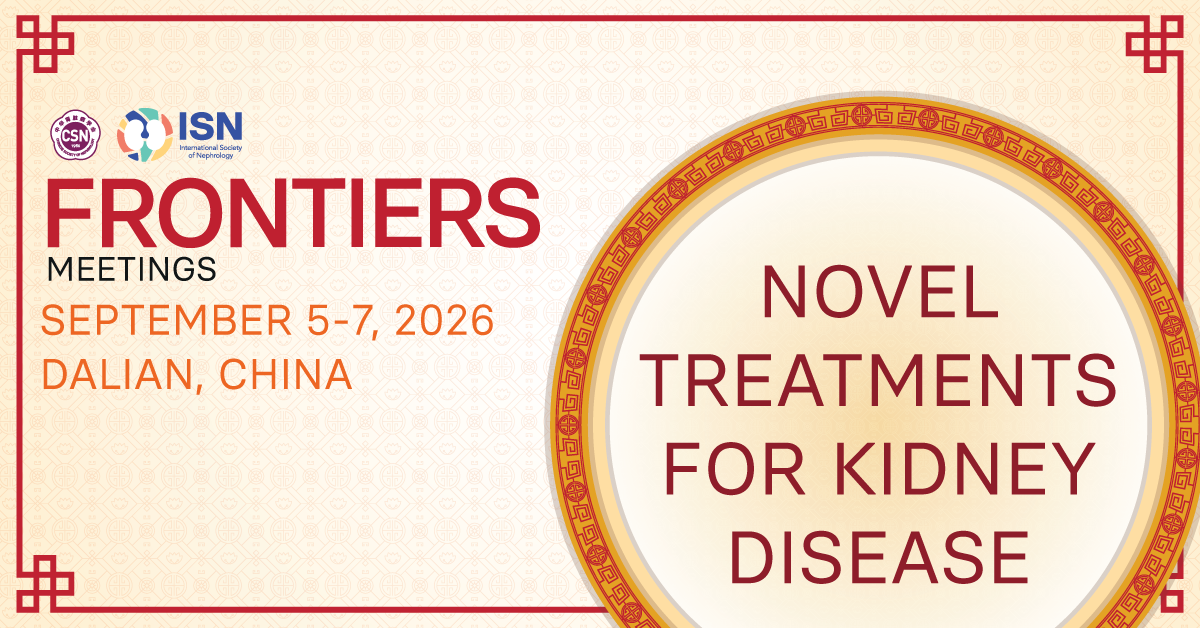
Be part of this vibrant exchange of knowledge and innovation at the ISN Frontiers Meeting 2026.
Explore the research presented at the ISN Frontiers Meeting 2026. Browse the abstracts in the Kidney International Reports® supplement.
Important dates
Submission opens
Submission deadline
Notification of acceptance
Abstract categories and topics
We welcome submissions under the following thematic pillars:
Cardio-Kidney-Metabolic Syndrome: Explore advances in cardio-renal-metabolic health, from novel clinical trials to real-world implementation.
- Clinical trials of new therapies (SGLT2 inhibitors, GLP-1 receptor agonists, MRAs, etc)
- Hyperphosphatemia management in kidney disease
- Anemia management in kidney disease
- Multi-organ protection and outcome studies
- Biomarkers and risk prediction models
- Implementation of therapies in practice
Rare Kidney Diseases: Present cutting-edge research on genetic and immune-mediated kidney diseases and access to therapies worldwide.
- IgA nephropathy
- Lupus Nephritis
- Complement-mediated kidney disease
- Alport syndrome, polycystic kidney disease (PKD), and other genetic kidney diseases
- Genetic risk factors (e.g., APOL1) and global perspectives
- Emerging therapies: siRNA, ASOs, gene editing/CRISPR
- Equity of access to therapies and registries/epidemiology
Other Topics: Abstracts on additional topics relevant to kidney health and disease are also welcome.
Acute Kidney Injury & Blood Purification Share insights on AKI prevention, detection, and management, including innovative extracorporeal therapies.
- Early detection and prognosis (biomarkers, AI tools)
- Sepsis-associated AKI and infection-related kidney injury
- Clinical and translational studies on AKI prevention and treatment
- Novel blood purification techniques
- Critical care and real-world implementation
Innovations & Artificial Intelligence in Nephrology: Highlight innovations shaping the future of kidney care, from AI-driven tools to digital health solutions.
- AI in prediction, diagnosis, prognosis, and clinical decision-support
- Integration of multi-omics (genomics, proteomics, metabolomics)
- Digital health, telemedicine, and remote patient monitoring
- Big data and machine learning applications
- Novel trial designs and research methods
Late-Breaking Clinical Trials: Showcasing groundbreaking research and newly emerging data shaping the future of kidney care
Note: A placeholder abstract must be submitted by April 15, 2026, to qualify for late-breaking submission.
(Read the specific conditions that apply to this category)
Abstract instructions and requirements
The online abstract submission portal will open in December 2025 and close on May 13, 2026. Abstracts received after the deadline will not be accepted.
Top-ranked abstracts will be selected for oral presentations; all others will be presented as posters during the meeting.
- Language: English
- Character limit: Up to 3,400 characters, including spaces. This excludes authors’ names, affiliations, keywords, and any tables or graphs inserted as images.
- Structure: Use a structured format with introduction, methods, results, and conclusion sections. Review carefully for typos, misspellings, and errors before submission.
- Co-authors: You may list up to 15 co-authors per abstract.
- Images: Images must be in JPEG or PNG format (maximum 640wx480h pixels, 1.5 MB).
- Case reports: Case reports that present novel hypotheses, pathologies, treatments, or ethical issues are welcome. However, they are only likely to be selected if the originality is highlighted effectively.
- A confirmation email will be sent within two business days to all abstract submitters to confirm the submission. If you do not see the email, please check your spam folder or contact [email protected] to ensure your submission was received.
- Encore abstracts: Allowed if permitted by both the initial and subsequent conferences. Authors must disclose this at the end of the abstract: “This abstract was also submitted for the [insert meeting title] congress.“
- Ethical compliance: Research must adhere to the Declaration of Istanbul on Organ Trafficking and Transplant Tourism.
- By submitting, you confirm that your work complies with ethical principles regarding live donation and research on human subjects.
- Generative AI disclosure: If AI-assisted tools were used in writing, consult the “Declaration of Generative AI and AI-Assisted Technologies” section and disclose accordingly during the submission process.
- Embargo policy: For abstracts accepted for presentation and publication during ISN Frontiers Meeting, the following embargo policy applies.
Abstract submission conditions
- Presenting authors must register for the congress by June 30, 2026, to have their abstract published and to present a poster. Failure to register by this date will result in the abstract not being published or presented.
- Presenting authors will be notified of acceptance by June 8, 2026.
- Presenters must register using the same email used for abstract submission. If they fail to do so and do not communicate the change of email to the Abstract team, the abstract might not be published in Kidney International Reports® or presented onsite. The organizers will not be held responsible for non-publication.
- ISN members from low- and lower-middle-income countries may benefit from travel grants that cover complimentary registration to the Frontiers Meeting and a fixed monetary contribution toward travel and accommodation. More information about the travel grants will be published in the upcoming months.
- If the presenting author is unable to attend, a co-author may present the abstract instead, provided they are registered. The original presenter must inform the Abstract team of the change by June 30, 2026, and provide the registration number of the new presenting author at the same time. Failure to do so will result in abstract withdrawal. No exceptions.
- Once submitted, abstracts cannot be edited or withdrawn.
- All copyrights are assigned to the International Society of Nephrology (ISN).
- All submitted abstracts will be considered for poster presentations.
Late-breaking clinical trials abstracts should showcase groundbreaking data and significant advancements that would not have been available for the regular abstract deadline.
Key considerations
- These abstracts highlight novel, practice-changing studies, including the latest trial data and research findings.
- This is not an extension of the general submission deadline.
- A placeholder abstract must be submitted during the regular submission period (deadline: May 13, 2026).
Conditions
- Accepted abstracts will be published online in Kidney International Reports® upon author confirmation. No printed abstract book will be available.
- Selected abstracts may be invited for oral presentation at the Frontiers Meeting.
- Presenting authors must register for the congress by June 30, 2026, to have their abstract published and to present a poster. Failure to register by this date will result in the abstract not being published or presented.
- Presenters must register using the same email used for abstract submission. If they fail to do so and do not communicate the change of email to the Abstract team, the abstract might not be published in Kidney International Reports® or presented onsite. The organizers will not be held responsible for non-publication.
- ISN members from low- and lower-middle-income countries may benefit from travel grants that cover complimentary registration to the meeting and a fixed monetary contribution toward travel and accommodation. More information will be published in the upcoming months.
- If the presenting author is unable to attend, a co-author may present the abstract instead, provided they are registered.
- The original presenter must inform the Abstract team of the change by June 30, 2026 and provide the registration number of the new presenting author at the same time. Failure to do so will result in abstract withdrawal. No exceptions.
- Only abstracts with a placeholder submission by May 13, 2026, will be considered.
- All copyrights are assigned to the International Society of Nephrology (ISN).
- To submit a late-breaking clinical trials abstracts: log in to your congress profile, go to My Abstracts > Submit New Abstract > Select “Late-breaking Abstract Submission”.
Awards
ISN members young nephrologists, 40 years and younger (born in 1986 and after), submitting an abstract(s) for the ISN Frontiers Meeting 2026 will be considered for the Young Nephrologist Award.
The winner(s) will be recognized during one of the meeting sessions, suggested as a possible speaker for future WCN, subject to topic relevance and will also be considered for an oral abstract presentation during the ISN Frontiers Meeting 2026.
If you would like to be considered for the ISN Young Nephrologists Award, select the checkbox to indicate you are a young nephrologist during the abstract submission process.