
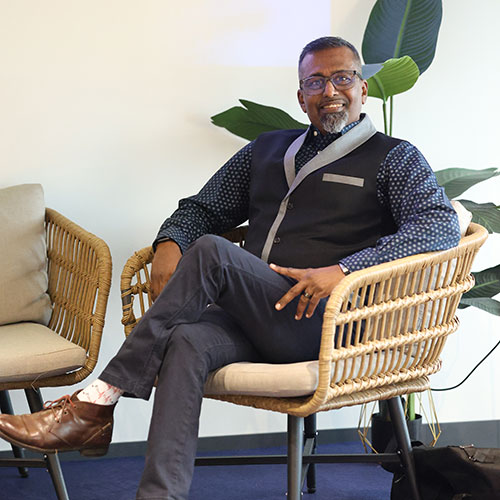
Manvir Victor
Malaysia
Living with the Disease: What is the most significant or defining aspect of living with kidney disease for you personally?
The most significant aspect of this disease for me has been its debilitating nature. From day one, it was never explained that several conditions would result from this diagnosis. All the healthcare personnel told me that dialysis was the only answer for this diagnosis and that I would be able to have a normal enough life with it.
The truth has never been further from the reality of that statement.
Being on dialysis for 10 years has caused my body irreparable harm. My heart, my hormones, my gut health, and general mental well-being have taken a massive toll that no one warned me about at any point.
With every new complication, new medications and more expenses followed.
The lack of information, education and awareness chipped away slowly but surely at the life I had before diagnosis. I seemed to get weaker and weaker as the years progressed, and spent more time and money in hospitals as a result.
The Diagnostic Journey: Please describe your experience with the diagnostic process. Was it quick and easy, or was it challenging/delayed?
When I was diagnosed in 2001, there was little or no screening. It was unheard of and resulted in many people having late diagnoses, which is still the case today.
The first nephrologist I met who diagnosed me is a person whom I deem the worst doctor in the world! His callous attitude, as well as the demeaning way he spoke to me, was so insulting to a human being. To this day, those fateful words and the way in which he delivered them are imprinted on my memory.
The process was made so much better by the second and subsequent doctors, but every step of the diagnosis journey was taken alone. This was at a time when little or no information was available, since Google didn’t exist.
Nobody told me anything; I just went to the designated places I was asked to be and waited to be “worked on” by whoever was in charge, with no information.
It seems like I was merely a hamster on a wheel. Everyone could see what I was going through, except me. I just had to keep moving.
Every step was challenging, as I didn’t know what it would bring and what would happen next. I just sat, hoping for the best, not even knowing what the best would look like.
Everyday Barriers: What are the everyday practical or emotional barriers you encounter while living with kidney disease (e.g., related to work, social life, treatment access, diet, or emotional well-being)?
These barriers still exist today. Once I had my transplant, I thought, since I am relatively healthy again, I could get a job. How wrong I was.
After multiple job applications, the fact that I was on dialysis for 10 years and the time tunnel that healthcare lives in were clearly barriers to employment. Even today, doctors cannot give us a clean bill of health or promote transplantation as a superior way to “cure” a patient.
Health policy recognizes that it needs to do more to promote kidney transplant patients as “healthy,” but no progress has been made on this. They look at us and expect us to come and help them with their work to promote screening, awareness, etc., but there is no remuneration for any of the work we do. So, how do they really want us patients to make a living?
This struggle that many patients go through is often overlooked. Hence, we have taken the initiative to shed light on this issue through our own organization, Malaysian Transplant Heroes. By doing this, we not only create activities and avenues for patients to showcase their talents, but also raise awareness for a life after the disease.
This is where we have found the role of Big Pharma to be terribly lacking. The tried-and-tested path of only engaging with healthcare professionals has made them blind to the actual beneficiaries of their work, i.e., the patients.
The next generation of healthcare professionals is what I am personally optimistic about. They’re growing up in a different world and realize that many things are left to them to change, especially because the evolution of healthcare has been very dynamic and quick, but stunted by outdated processes.
The mental health of those with lived experience has still not been considered at all. There are still no counselors for us. The only help we have access to is our patience. And as we await to be educated and empowered to help others within a system that considers us worthy, we continue to help each other outside of the system.
The importance of the work that we do in our countries, regions and globally has been proven by the ISN Patient Liaison Advisory Group and its key members. As we await the Eureka moment when we are recognized as worthy partners by healthcare professionals, we continue to blaze a trail.
In the end, if we expect the world to take patients and those with lived experiences seriously, we need health systems to stand up and recognize our role in this first.