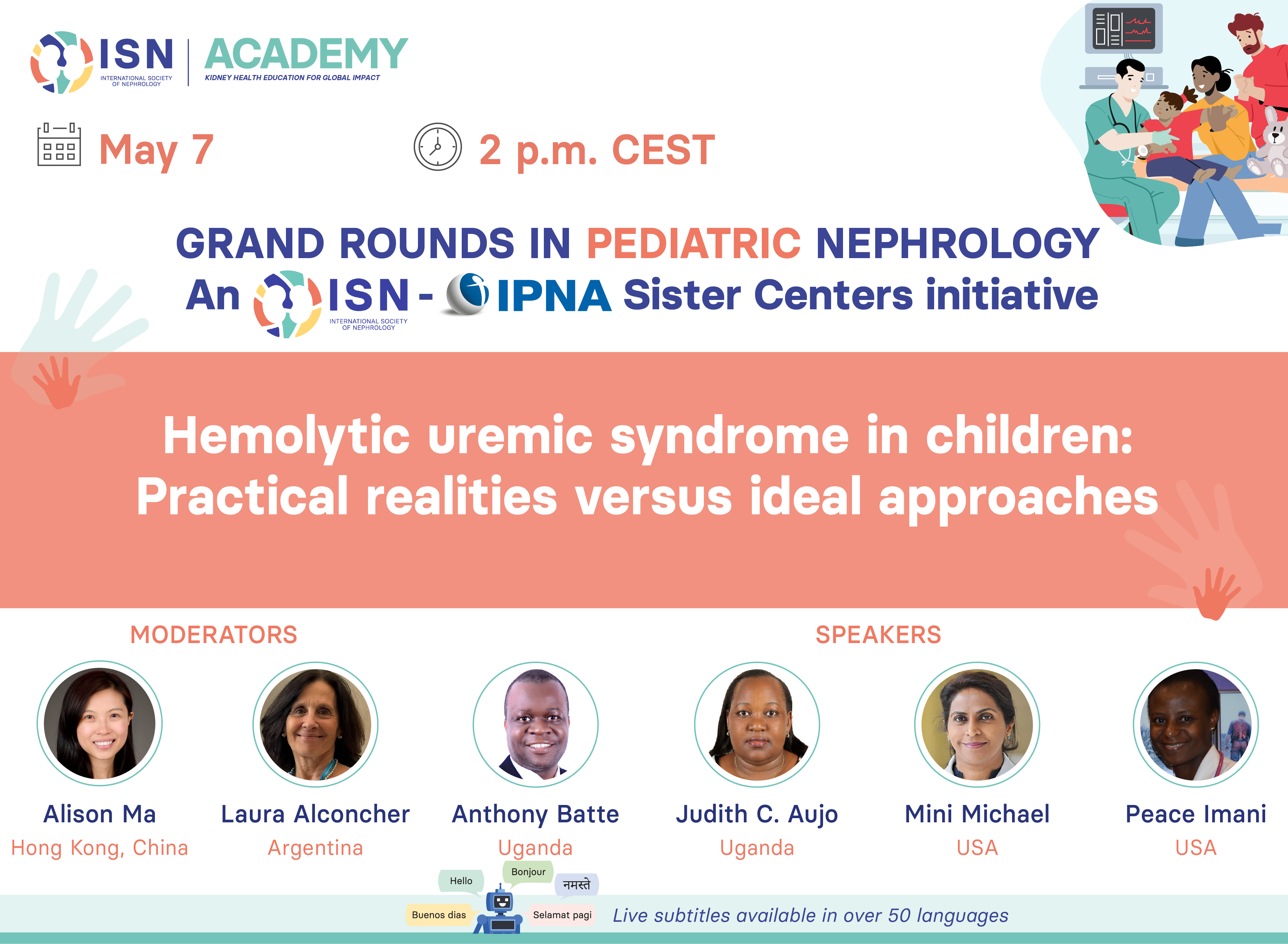
ISN-IPNA Webinar: Hemolytic Uremic Syndrome in Children: Practical Realities versus Ideal Approaches
- 2:00 PM CEST
Haemolytic uremic syndrome (HUS) is one of the commonest causes of acute kidney injury (AKI) worldwide. It is characterised by a triad of microangiopathic haemolytic anaemia, thrombocytopenia and acute kidney impairment. HUS may occur following infection most often following diarrheal illness caused by E.coli O157:H7 (typical HUS) or result from complement-mediated thrombotic microangiopathy (TMA) due to genetic or acquired dysregulation of the alternative complement pathway (atypical HUS).
AKI in low and low middle income countries is well described in the literature as predominantly community-acquired, affecting younger populations and commonly following infectious illnesses such as malaria and sepsis. In most of sub-Saharan Africa, severe malaria is among the leading causes of AKI. Within this context, HUS particularly in setting with a rising burden of severe malaria and significant diagnostic limitations, often becomes an overlooked or under-recognized cause of AKI
We present here a summary of four patients managed at our centre who demonstrated clinical features suggestive of, and laboratory findings consistent with HUS, within the limits of available diagnostic capacity. We share these cases to underscore the challenge of diagnosis and management and to emphasize the need for a high index of suspicion among clinicians. All patients tested negative for malaria by peripheral blood smear and malaria rapid diagnostic test (MRDT), despite some having received malaria treatment prior to referral.
The diagnostic process can be complex and is not always straight forward, in a child presenting with anaemia, thrombocytopenia and kidney injury, with or without a preceding diarrheal illness. Confirming the diagnosis is essential to ensure timely and appropriate treatment, which is critical for optimal outcomes. Support from the haematology unit, particularly their prompt turnaround of peripheral smear evaluations was invaluable in guiding clinical decision making.
Learning objectives:
- Review the definition and etiological categories of HUS, with emphasis on distinguishing typical from atypical forms.
- Review the role of complement system in the pathogenesis of complement-mediated haemolytic uremic syndrome
- Outline a systematic diagnostic approach for evaluating a child with suspected haemolytic uremic syndrome
- Discuss evidence-based management strategies and prognosis of children with haemolytic uremic syndrome
Further reading:
- A. Olotu, S. Mithwani, and CRJC Newton Trop Doct. 2008 July; 38(3): 165–167. doi:10.1258/td.2007.070095. Haemolytic Uraemic Syndrome in children admitted to a rural District Hospital in Kenya
- Silviu Grisaru (2014) Management of hemolytic-uremic syndrome in children, International Journal of Nephrology and Renovascular Disease, 231-239, DOI: 10.2147/IJNRD.S41837
- Devleta Hadžić, Lejla Osmančević, Evlijana Zulić, Nedima Atić, Aida Mršić, Razija Spahić, Luna Ibrelić. Hemolytic uremic syndrome in a Pediatric Intensive Care Unit- Rapid review with case series. DOI: 10.5457/701
- Maurizio Salvadori, Elisabetta Bertoni; Update on hemolytic uremic syndrome: Diagnostic and therapeutic recommendations World J Nephrol 2013 August 6; 2(3): 56-76.
Moderator
Alison Ma (HK)
Laura Alconcher (Argentina)
Speakers
Anthony Batte (Uganda)
Judith C. Aujo (Uganda)
Mini Michael (USA)
Peace Imani (USA)