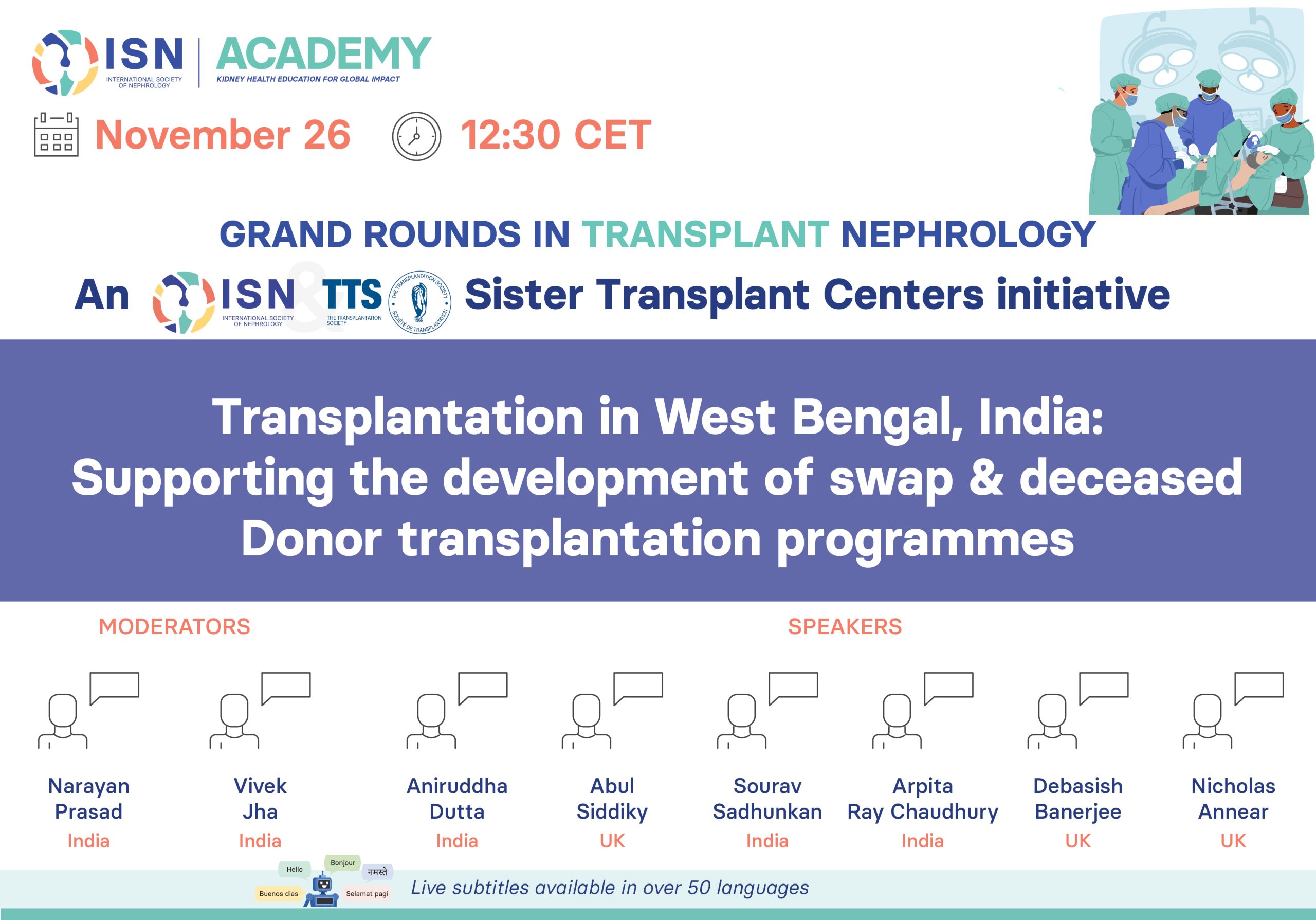
ISN-TTS Webinar: Kidney Transplantation in West Bengal, India: Supporting the Development of Swap & Deceased Donor Transplantation Programmes
- 12:30 CET
Organ transplantation rates and characteristics differ significantly between West Bengal, India, and London, UK, driven by distinct legal frameworks, cultural attitudes, and infrastructure capabilities. Improving outcomes requires addressing region-specific barriers while fostering international clinical collaboration. In this session, through case studies, we highlight how the ISN-TTS STC A initiative is helping to develop improvements in the transplant programme: reducing the immune suppression burden in live donor transplantation through the ‘kidney swap/paired donation’ scheme, and in increasing deceased donor transplantation rates – through support and optimization of existing DBD infrastructure, and establishing a DCD transplant service in West Bengal, India.
Learning objectives:
- How to develop a Kidney Swap/Paired donation transplant scheme.
- How to address barriers to optimizing the DBD & DCD kidney transplant programmes.
- Understanding obstacles to optimising the immune suppression protocol in transplantation
Further reading:
- Kher V, Sahay M, Jha PK. Kidney Transplantation in India—Past, Present and Future. Indian J Nephrol. doi: 10.25259/IJN_540_2024
- Kute V.B. et al Operational guidelines for kidney swap transplantation in India: an ISOT-NOTTO Delphi consensus. Lancet Regional Health Southeast Asia
- Ghazanfar, A., Chaudhury, A.R. (2026). Extended Criteria DCD Donor-Kidney Transplantation. In: Kolte, S.P., Bhawane, A.R., Kumar, A., Sharma, A., Kute, V.B., Balwani, M.R. (eds) Organ Donation After Circulatory Death. Springer, Singapore.
- Balwani MR, al. ISOT position statement on the feasibility of an organ for transplantation from brain-dead deceased donors: a Delphi consensus. Lancet Reg Health Southeast Asia. 2025 Jul 16;39:100628. doi: 10.1016/j.lansea.2025.100628. PMID: 40697564; PMCID: PMC12282266.
- Pradeep A, Siddiky A et al. Organ donation among ethnic minorities: how UK primary care can promote it. Br J Gen Pract 2018 Mar; 68(668): 134-135. DOI: 10.3399/bjgp18X695093
Moderator
Speakers