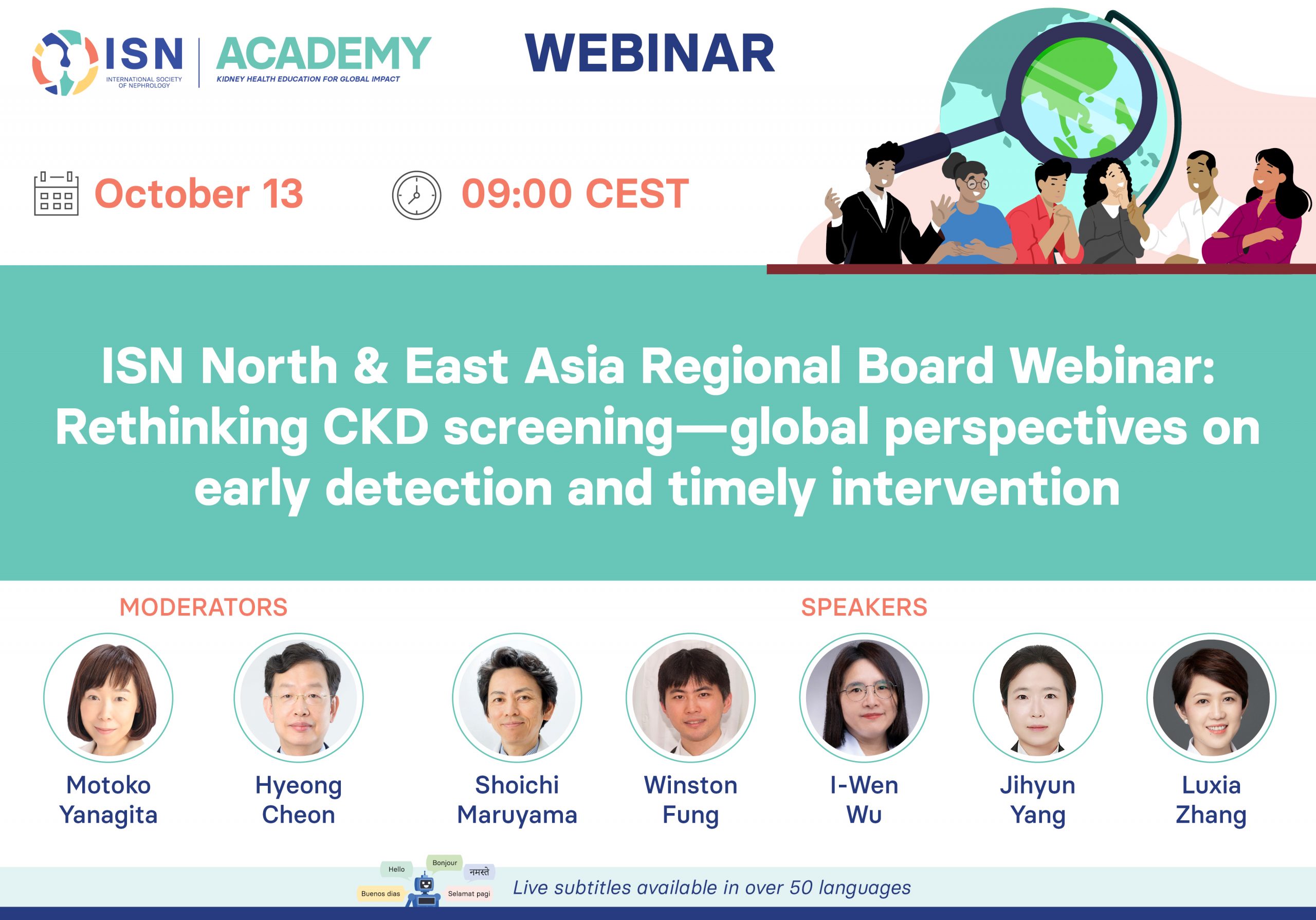
ISN North & East Asia Regional Board Webinar: Rethinking CKD screening: global perspectives on early detection and timely intervention
- 09:00 CEST
CKD has emerged as a major global health burden, affecting nearly 10% of the world’s population and contributing significantly to morbidity, mortality, and healthcare costs. Despite substantial progress in therapeutic interventions, including novel kidney-protective agents, the full benefits of these treatments can only be realized if CKD is detected early enough to prevent its progression. However, screening strategies for CKD vary widely between countries, reflecting differences in healthcare infrastructure, resource allocation, prevalence of risk factors, and policy priorities.
In some high-income nations, routine screening for CKD is incorporated into national health check-up programs, often targeting populations at risk, such as individuals with diabetes, hypertension, and a family history of kidney disease. For example, Japan has implemented urinary protein testing within community health examinations, contributing to the relatively early identification of CKD. Similarly, Taiwan has developed robust screening initiatives as part of its National Health Insurance System. These models have demonstrated the potential of systematic screening to improve early detection and timely referral, ultimately reducing the burden of end-stage kidney disease (ESKD).
In contrast, CKD screening remains insufficient or absent in many countries, including both developed and developing nations. Limited resources, competing health priorities, and uncertainty regarding cost-effectiveness have hampered implementation. In such settings, patients are frequently diagnosed at advanced stages of CKD, when therapeutic options are limited, and the risk of progression to dialysis or kidney transplantation is high.
The debate surrounding CKD screening thus centers on several key questions: Should screening be universal or restricted to high-risk populations? What is the most effective and cost-efficient method: urinary albumin testing, eGFR assessment, or a combined approach? How should screening be integrated into existing health check-up systems, especially in low- and middle-income countries with constrained resources? Importantly, how can the benefits of early detection be translated into timely referral, diagnosis, and initiation of therapy?
This webinar will bring together international experts to critically compare CKD screening practices in different countries. The panelists will discuss the advantages and limitations of national programs, the role of targeted versus population-wide screening, and the economic implications of different strategies. By integrating perspectives from diverse healthcare systems, this session will provide participants with a comprehensive framework to evaluate and improve CKD screening in their own regions. The ultimate goal is to identify the best practices that are both effective and feasible, thereby reducing the incidence of late-stage CKD and ensuring that more patients benefit from advances in therapy.
Learning objectives:
- Compare and contrast CKD screening strategies across countries, including national health programs, targeted high-risk approaches, and their outcomes.
- Evaluate the benefits, limitations, and cost-effectiveness of different screening models, and their impact on timely diagnosis, treatment initiation, and progression to ESKD.
- Discuss practical recommendations for implementing or improving CKD screening, including identifying optimal target populations, timing, and methods tailored to diverse healthcare systems.
Further reading:
- The burden of CKD in Asia region: a review of the evidence, current challenges, and future directions. Kidney Res Clin Pract 2025; 44: 411-433
- Framework of Guidelines for Management of CKD in Asia. Kidney Int Rep. 2023; 9: 752–790
- ISN-KDIGO CKD Early Identification & Intervention Toolkit
- Perspectives on early detection of chronic kidney disease: the facts, the questions, and a proposed framework for 2023 and beyond. Kidney Int. 2023; 103, 1004–1008
- The case for early identification and intervention of chronic kidney disease: conclusions from a Kidney Disease: Improving Global Outcomes (KDIGO) Controversies Conference. Kidney Int. 2021; 99, 34–47
- Early Identification of CKD—A Scoping Review of the Global Populations. Kidney Int Rep. 2022; 7, 1341–1353
The perspectives from the region are available on the ISN Academy.
Presentations:
CKD Screening in China: Evidence and Implementation
Insights and Korean perspectives
Who receives CKD screening in Japan, and how widely?
Moderator
Motoko Yanagita
Hyeong Cheon Park
Speakers
Shoichi Maruyama
Winston Fung
I-Wen Wu
Jihyun Yang
Luxia Zhang