Read the latest summaries from the ISN Journal portfolio
Kidney International®
Pegcetacoplan prophylaxis for recurrent C3 glomerulopathy with multifactorial genetic background
C3 glomerulopathy (C3G) has a high risk of recurrence after kidney transplantation, and there is limited evidence on how best to prevent it.
This case report describes a child with severe, early-onset C3G and a complex genetic background who received pegcetacoplan before and after a living-donor kidney transplant as prophylaxis against recurrence.
The authors report that eight months after transplantation, kidney function remained stable; complement levels were normal, and protocol biopsies showed no evidence of recurrent C3G.
Neonatal acute kidney injury: diagnosis, recognition and prevention
Neonatal acute kidney injury (AKI) affects around one-third of babies in neonatal intensive care, but early diagnosis remains difficult with current measures.
This narrative review examines advances in neonatal AKI definitions, risk recognition, biomarkers, prevention, and quality improvement strategies.
The authors highlight practical measures, including education, AKI protocols, nephrology involvement, and nephrotoxic medication stewardship, that can improve recognition and reduce AKI rates.
Kidney International Reports®
Catastrophic flooding can severely disrupt dialysis services, but evidence on system-level vulnerabilities during disasters is limited.
This study surveyed all 20 dialysis centers in Songkhla Province after the 2025 Hat Yai floods to assess service disruption and preparedness gaps.
More than half of centers temporarily closed, with water supply failure emerging as a critical vulnerability, prompting the authors to propose a five-part preparedness model covering data, emergency coordination, communication, resources, and recovery.
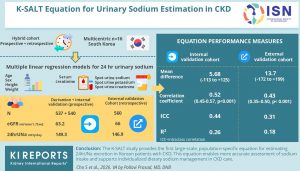
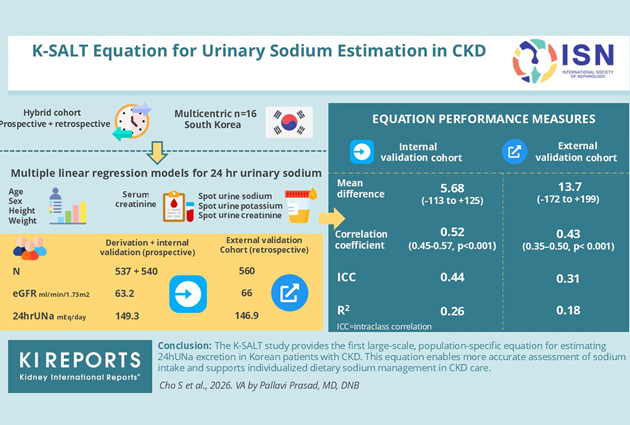
K-SALT equation for urinary sodium estimation in CKD
Accurately estimating sodium intake is important in chronic kidney disease (CKD) care, but existing equations for estimating 24-hour urinary sodium have limited validity in Korean populations.
This study developed and validated the K-SALT equation using data from 1,637 patients with CKD across 16 Korean teaching hospitals.
K-SALT outperformed existing formulas and remained robust across CKD stages and subgroups, supporting more accurate and individualized dietary sodium assessment.
Kidney International Case Reports™
Podocyte infolding glomerulopathy (PIG) is a rare kidney lesion whose underlying mechanisms remain unclear.
This case report describes a 75-year-old man whose repeat kidney biopsy, four years after an initially minor podocyte injury, showed PIG-like changes, endothelial alterations, and immune deposition without typical electron-dense immune deposits.
The findings suggest that humoral immune mechanisms may contribute to podocyte injury and PIG development, offering further insight into the disease’s pathogenesis.
Shōshin beriberi is a rare but potentially fatal cause of circulatory shock and lactic acidosis that can be overlooked in patients on maintenance hemodialysis.
This case report describes a woman in her 30s who developed refractory shock and worsening lactic acidosis during a deceased-donor kidney transplant.
After other causes were excluded, presumed thiamine deficiency was treated with high-dose intravenous thiamine, with complete resolution of the lactic acidosis within 24 hours.