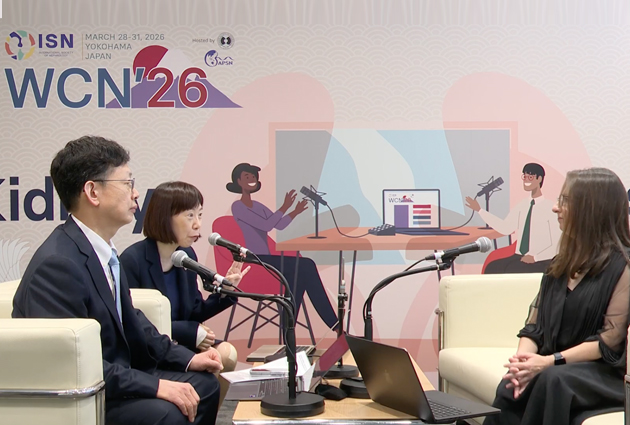
Tune in to regional perspectives from the WCN’26 Kidney Studio
What do kidney care priorities look like across ISN regions?
In a series of WCN’26 Kidney Studio interviews, several ISN regional board chairs and deputy chairs share perspectives on the challenges and opportunities shaping kidney care in their regions.
The interviews show how regional leadership connects the ISN’s global mission with local realities, from earlier diagnosis and workforce development to access, education, and awareness.
Oceania and South East Asia: Expanding access and reducing practical barriers
“The future is like a vision. We want to expand accessibility for kidney care into every country in the region and save kidney disease patients’ lives.” Talerngsak Kanjanabuch
ISN Oceania and South East Asia Regional Board Chair Talerngsak Kanjanabuch highlights the need for kidney care models that reduce financial and practical barriers for patients, such as for peritoneal dialysis, which can help limit travel and transport costs. He also draws attention to Thailand’s “7.2 Million Thais Know Their Kidney Disease Risk” project, a nationwide screening campaign designed to identify people at risk and support timely care before kidney failure develops.
North and East Asia: Collaboration across diverse health systems
“The regional board platform helps us collaborate more effectively. It is very important for sharing knowledge and supporting programs across the region.” Hyeong Cheon Park
North and East Asia Regional Board Chair Hyeong Cheon Park and Deputy Chair Motoko Yanagita reflect on the value of WCN as a platform for scientific exchange, networking, and inspiring younger generations of nephrologists and medical students to engage with the global kidney community. They also highlight the importance of regional collaboration in North and East Asia, where health system capacity varies across its seven countries, and recognize the ISN’s role in supporting education and capacity-building to help address disparities and strengthen kidney care.
South Asia: Raising awareness and detecting CKD earlier
“Awareness of kidney disease in the general population, unfortunately, is very low. People know about cardiac disease and hypertension, but hardly anybody is aware of kidney disease.” Sandeep Mahajan
South Asia Regional Board Chair Muhammed Rafiqul Alam and Deputy Chair Sandeep Mahajan highlight the scale and complexity of CKD in a region with a high disease burden and major gaps in early diagnosis, screening, and access to kidney replacement therapy. Alongside diabetes and hypertension, they discuss region-specific drivers of kidney disease, including obstetric acute kidney injury, snakebite, dengue, malaria, environmental toxins, pesticides, unsafe drinking water, and unregulated use of medicines. They emphasize the need to integrate CKD into noncommunicable disease programs, expand early screening through primary care, improve public awareness, and strengthen equitable access to dialysis and transplantation.
NIS and Russia: Supporting the future nephrology workforce
“The young are the future of the nephrology workforce in the region. It’s crucial to understand what their needs are.” Nikolay Bulanov
Newly Independent States and Russia Regional Board Chair Kirill Komissarov and Deputy Chair Nikolay Bulanov discuss the region’s limited nephrology workforce and the challenges facing early-career nephrologists. They highlight findings from a regional survey of young nephrologists, including concerns around training, salary, access to resources, communication skills, and work-life balance. The interview emphasizes the importance of education, mentorship, peer support, and the ISN Academy and grant opportunities in helping young specialists advance professionally and strengthen kidney care.
Western Europe: Earlier diagnosis to unlock new treatment options
“The diagnosis of chronic kidney disease costs less than a coffee. So go and diagnose the patient now that we have new treatments to avoid chronic kidney disease progression and help your colleagues do that as well.” Maria José Soler Romeo
Western Europe Regional Board Chair Maria José Soler Romeo and Deputy Chair David Wheeler highlight the need to improve early diagnosis of chronic kidney disease (CKD) in people with type 2 diabetes. With new therapies now available to slow CKD progression, including SGLT2 inhibitors, GLP-1 receptor agonists, and mineralocorticoid receptor antagonists, they emphasize that primary care teams need support to identify patients earlier and start kidney-protective treatment before complications advance.
Watch all WCN’26 Kidney Studio video interviews