
Celebrating a transformative year in global kidney health — 2025 in review
President Marcello Tonelli celebrates milestone achievements and global progress for kidney health in 2025
Dear ISN community,
As 2025 comes to a close, I am proud to reflect on a truly transformative year for the global kidney community. Historic milestones have elevated kidney health on the world stage, including the adoption of the first-ever WHO kidney health resolution and recognition in the UN political declaration on noncommunicable diseases (NCDs), which references kidney health three times. These achievements confirm that kidney disease is finally recognized as a global health priority and an integral part of the NCD agenda.
In 2026, the ISN will prioritize activities that help to translate these commitments into tangible national action — because kidney health cannot wait.
Membership growth and engagement
 The ISN community continued to expand and diversify in 2025, reaching 10,300 members, supported by three new Collective-member societies (now 36) and six new Affiliated societies (125 total), with 19 represented at the Affiliated Societies Meeting at WCN’25. Excellence across the community also grew with 72 new members receiving Fellows of the ISN designation this year.
Our members span every region and income level, reinforcing the ISN’s global identity and collective strength. To enhance members’ experience within our growing community, we also launched a new ISN portal, offering streamlined access to benefits and resources and helping members connect globally, share expertise, and access best practices to improve patient outcomes.
A dynamic gathering for kidney science and global presence
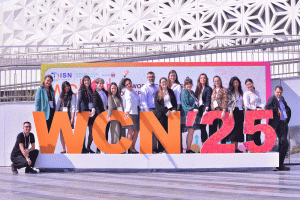 The global kidney care community came together in February at WCN’25 in New Delhi, India, engaging with world-class scientific content that set the stage for a year of tangible progress in advancing global kidney care. The congress brought together 3,746 delegates from 112 countries.
Beyond WCN, the ISN continued its presence at events throughout the year, endorsing 63 meetings across 41 countries. A Scientific Writing Course took place in Kenya, and editions of the Primer Course in Glomerular Diseases were held there, in Taiwan, and in the Czech Republic. In addition, four expert forums were held, one on complement therapeutics in C3G & IgAN, one on B cell targeting in glomerular disease, and two on cardio-kidney-metabolic health. This global engagement strengthens partnerships and fosters collaboration toward advancing kidney care everywhere it’s needed. I encourage you all to register for WCN’26 in Japan!
Driving momentum from public engagement to policy change

World Kidney Day led the charge to raise the profile of kidney health worldwide in March, reaching 170 million people through 2,500 activities in 85 countries, lighting 35 landmarks in 14 countries, and generating 70,000 engagements, with support from more than 18 global celebrities.
The ISN also helped drive global policy momentum this year. At WHA78, we delivered a joint statement and hosted a high-level ISN–Devex event. At UNGA80, the ISN-led event “Kidney Health Can’t Wait: Turning Commitments Into Action” advanced the conversation on translating global pledges into national strategies to bridge care gaps.
To support governments in implementing the WHO kidney health resolution, the ISN launched an implementation strategy aligned with the ISN Manifesto. Designed to translate global commitments into tangible, country-level progress, the ISN would like to build on lessons from national pilot programs and partners’ initiatives to develop adaptable tools, resources, and policy models for regional and global use. There will be a Global Implementation Summit at WCN’27 to review progress.
Supporting career growth and clinical expertise
 Accessible from anywhere in the world, the ISN’s educational content helps strengthen best practices and improve kidney care even in underserved regions.
In 2025, the ISN Academy welcomed a new record of 442,591 visitors, while 57 webinars and 8 podcasts — downloaded 1,788 times — delivered accessible, high-quality learning to kidney care professionals, supporting career growth, research literacy, and clinical excellence.
Academy members earned 1,668 CME credits, with standout courses including the “ISN Fellowship Foundation Course,” “Electrolytes and Acid-Base Disorders Curriculum,” and “Rare Diseases: MGRS & Amyloidosis Course,” helping kidney doctors everywhere grow and develop professionally.
Research that maps, measures, and moves kidney care forward
ISN-supported research continues to expand the global kidney knowledge base, with 10 publications this year appearing in leading journals, including one from Emerging Leaders Program members on the role of non-physician health workers in kidney care and another on the PARADIGM consensus meeting on rethinking kidney research trials. Several studies, including those in PLOS Global Public Health, drew on data from the ISN‑Global Kidney Health Atlas (ISN‑GKHA) to examine global access to kidney care, therapies, and transplantation, while other papers addressed home dialysis, therapy optimization, and professional development for nephrology teams.
The ISN‑GKHA Interactive Map, launched this year, has already attracted 5.3K visitors in its first 10 months. It allows users to effortlessly explore trends by country, region, and income group, turning data into actionable insights for policymakers and clinicians worldwide.
 The ISN also released six Guides for Everyone, translating complex trial results into practical insights, alongside 84 ISN TrialWatch (previously Global Trials Focus) summaries spotlighting the most impactful studies for kidney care, ensuring that the latest evidence informs clinicians worldwide and advances shaping kidney care.
Grants that build capacity and transform care where it’s most needed
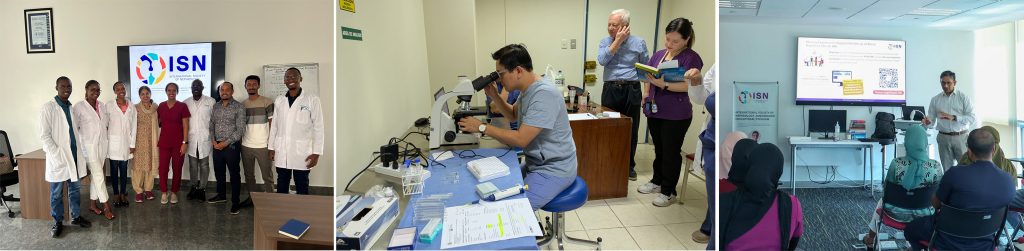
ISN Grants work together to strengthen kidney care worldwide: Fellowships develop future leaders, Sister Centers partnerships provide long-term mentorship, Continuing Medical Education courses share expertise, and Educational Ambassadors deliver tailored, hands-on training. These initiatives are made possible through your support, translating directly into tangible improvements in kidney care services around the world. Here’s a snapshot of what your support enabled in 2025.
- ISN Educational Ambassadors helped enhance renal pathology services in Rwanda, strengthen interventional nephrology in India, and reintegrate urinary sediment analysis in Peru
- Emerging Leaders Program Cohort 3 members helped advance the global dialogue on access to CKD diagnostics, reflecting the next generation of nephrology leadership in action
- Sister Renal Centers in India, Sri Lanka, and Myanmar significantly advanced pediatric kidney care
- The ISN–TTS Sister Transplant Centers Program has improved transplant services in Nepal and the Philippines
In addition, the ISN supported 14 Interventional Nephrology Scholars, 4 Clinical Research Program grantees, and 23 Fellows from 15 countries — expanding expertise, innovation, and impact in kidney care in underserved areas.
Earlier this year, the ISN began supporting the CARE-NEPH East Africa Project, a five-year partnership led by national kidney societies in Kenya, Uganda, Ethiopia, and Tanzania. Building on the region’s strong foundation of ISN training and collaboration — including an ISN Regional Training Center the initiative aims to expand the nephrology workforce, strengthen subspecialty expertise, and improve kidney care skills across local health systems. Designed as a scalable model for other regions, CARE-NEPH is set to create lasting, self-sustaining improvements in kidney care throughout East Africa.
Enhancing kidney care through toolkits and resources
 The ISN’s toolkits directly support our mission by offering practical guidance that strengthens clinical capacity, reduces disparities in kidney care, and connects our global community through shared standards and expertise. Launched in 2025, the Optimization of SGLT2i Therapy Toolkit includes six practical tools to guide clinical practice, covering topics such as therapy usage and patient communication.
Existing toolkits were also expanded with valuable resources and provided in additional languages: An infographic on ADPKD was added to the Rare Kidney Disease Toolkit, the RAASi Optimization Toolkit now includes and a toolbox on starting and sustaining early CKD detection and intervention programs was added to the ISN-KDIGO Early Identification and Intervention Toolkit.
Looking towards 2026
 This month, the ISN launched Kidney International Case Reports (KICR), a new open-access journal sharing real-world clinical insights from around the globe. We’re looking forward to seeing how this addition will help highlight innovative approaches in clinical practice, including from resource-limited settings, accelerate clinical learning for the ISN’s worldwide community, and support early-career clinicians.
 We also look forward to the ISN Frontiers Meeting in Dalian, China, from September 5–7. This immersive, research-driven program will connect the community across cardiovascular-kidney-metabolic syndrome, rare kidney diseases, acute kidney injury, and blood purification, as well as innovations such as artificial intelligence in nephrology.
My first year as ISN President has reinforced how powerful our community is when working toward a common goal. Your dedication made 2025 a landmark year for bridging gaps and building capacity in kidney care and elevating kidney health on the global health agenda. As we move into 2026, our focus will be on turning global commitments into national action — and on improving care for the millions who depend on it. Thank you for your trust and partnership.
I wish you all the best for the year ahead, and I look forward to seeing you at WCN’26 in Yokohama!

Warm regards,
Marcello Tonelli
ISN president